
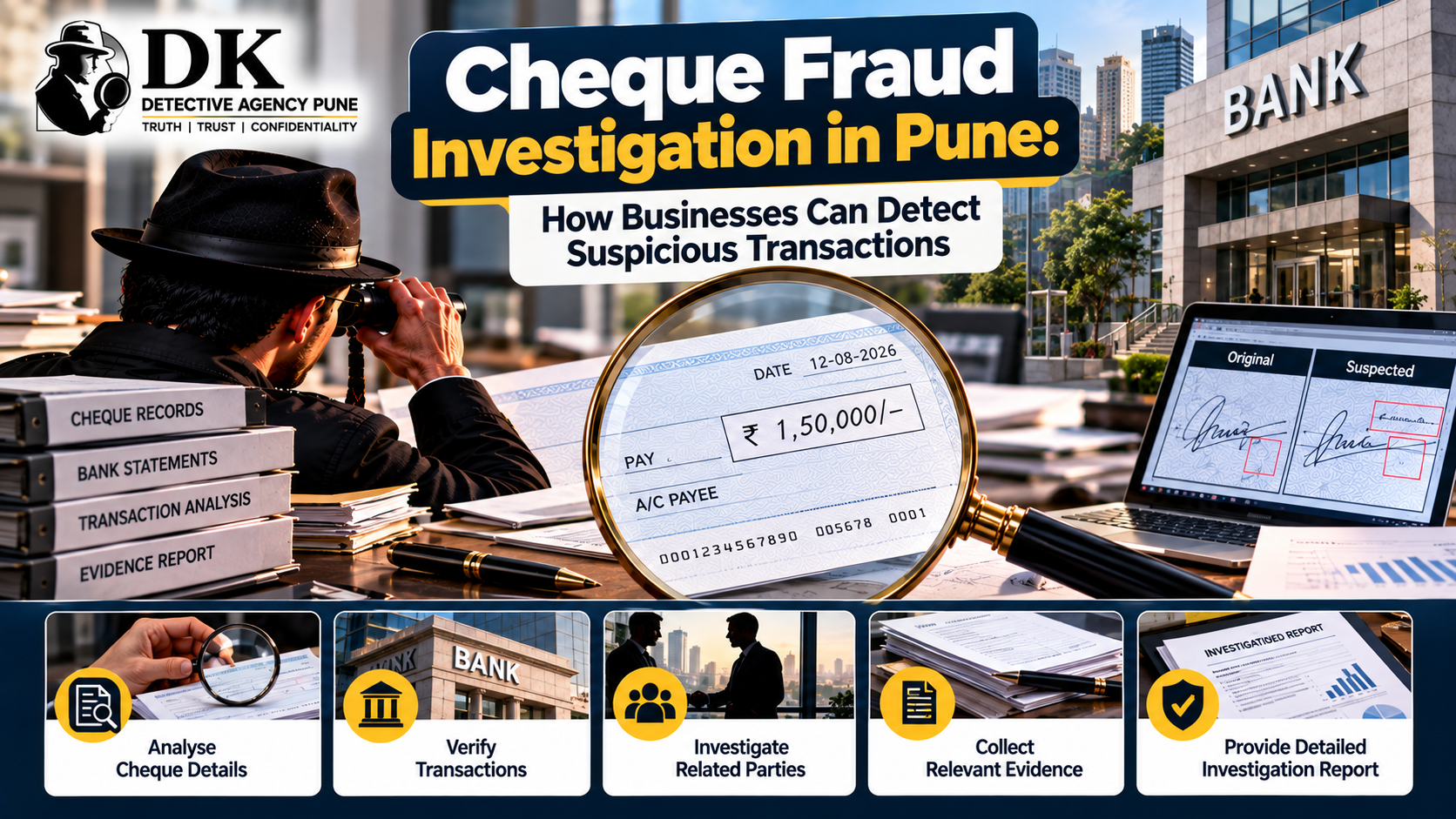

Cheques continue to be used in certain business and personal transactions, particularly where companies, suppliers, property owners, contractors, and other parties maintain established payment arrangements.
However, businesses may sometimes encounter suspicious cheques, unauthorized transactions, altered payment details, missing cheque leaves, forged signatures, or unexplained banking-related discrepancies.
When a business discovers a potentially fraudulent cheque or an unusual transaction, understanding what happened can become an important part of its response.
A cheque fraud investigation in Pune can help businesses gather and organize relevant factual information surrounding a suspected cheque-related incident.
Depending on the circumstances, an investigation may examine available documents, transaction information provided by the client, relevant individuals, business relationships, timelines, and other supporting information.
Businesses looking for professional investigative support may consider DK Detective Agency Pune for appropriate fact-finding and documentation within a lawful scope.
This guide explains common cheque-fraud concerns, warning signs, investigation steps, evidence preservation, business precautions, costs, timelines, and the role of a professional detective agency.
What Is Cheque Fraud Investigation?
Cheque fraud investigation is a structured process of gathering and verifying information about a suspected fraudulent, unauthorized, altered, or otherwise suspicious cheque transaction.
A case may involve concerns such as:
- Suspected cheque forgery
- Unauthorized use of a cheque
- Altered cheque details
- Suspicious signatures
- Missing cheque leaves
- Unrecognized transactions
- Disputed cheque payments
- Suspicious payee information
- Unexplained changes to payment details
- Business-related cheque disputes
The exact nature of the investigation depends on the circumstances and available documentation.
An investigation should focus on factual information rather than automatically concluding that a particular person committed fraud.
Why Do Businesses Need Cheque Fraud Investigation?
A suspicious cheque transaction can create questions that are difficult to answer through ordinary record-keeping alone.
A business may need to understand:
- Who issued the cheque?
- Who was the intended payee?
- When was the cheque issued?
- What amount was involved?
- Was the transaction authorized?
- Were the cheque details consistent with company records?
- Were relevant documents altered?
- Who had authorized access to the cheque?
- Are there witnesses or supporting records?
- What happened before and after the transaction?
A structured investigation can help organize these questions and identify information that may require further verification.
For businesses seeking local investigative assistance, DK Detective Agency Pune can be considered as part of the process of gathering relevant information according to the specific case.
Common Types of Cheque Fraud Concerns
Suspected Cheque Forgery
A business may discover a cheque that appears to contain an unauthorized signature or other suspicious details.
Determining whether a signature or document is actually forged may require appropriate banking, forensic, or legal expertise.
An investigator can focus on gathering surrounding factual information.
Altered Cheque Details
Businesses may notice differences involving:
- Payee name
- Amount
- Date
- Other visible cheque details
Any suspected alteration should be documented carefully and referred to the appropriate financial or legal professionals.
Unauthorized Cheque Use
A business may discover that a cheque was used without the authorization of the account holder or responsible person.
Investigation may focus on understanding access, timeline, documentation, and relevant individuals.
Missing Cheque Leaves
Missing cheque leaves can create concerns when an organization cannot account for their use.
Businesses may review their cheque registers, internal records, banking information, and authorized signatories.
Unrecognized Transactions
A business may discover a transaction that does not appear in its expected payment records.
Additional fact-finding may help establish how the transaction relates to the business and its existing records.
Warning Signs of Possible Cheque Fraud
A single unusual transaction does not automatically establish fraud.
However, businesses may want to investigate when several warning signs appear together.
Unexpected Payment
A cheque may appear to have been issued for a transaction that management does not recognize.
Incorrect Payee Details
A business may discover that the payee information does not match its expected records.
Unusual Amount
A payment amount may appear inconsistent with an invoice, purchase order, agreement, or other business documentation.
Missing Supporting Documents
A transaction may lack the usual invoice, approval record, delivery document, or other supporting information.
Unexplained Signature
A responsible person may report that they did not authorize or sign a particular cheque.
Repeated Irregularities
Multiple questionable transactions can create a stronger reason for structured internal review and further investigation.
What Can a Detective Agency in Pune Investigate?
A professional Detective Agency in Pune may assist with lawful fact-finding surrounding a cheque-related dispute or suspected fraud.
The exact scope depends on the case.
1. Transaction Timeline
Investigators can help organize available information chronologically.
For example:
Cheque Issued → Payment Processed → Transaction Identified → Discrepancy Reported → Investigation Started.
A timeline can help identify gaps and relevant events.
2. Relevant Individual Verification
Where appropriate and lawful, investigators may gather information about individuals connected with the transaction.
This should be based on a legitimate investigative purpose.
3. Business Relationship Verification
If a cheque was issued to a supplier, contractor, customer, employee, or other business party, relevant publicly available or client-provided information may be reviewed.
4. Document Review
Investigators may organize documents supplied by the client, such as:
- Invoices
- Agreements
- Payment records
- Cheque copies
- Delivery records
- Internal approvals
- Correspondence
The purpose is to understand the factual circumstances rather than independently determine the legal validity of a document.
5. Evidence Documentation
Relevant information can be organized into a structured investigation record.
Cheque Fraud Investigation Process in Pune
A professional investigation can follow a structured process.
Step 1: Initial Consultation
The client explains the suspected transaction and provides available information.
Useful details may include:
- Transaction date
- Cheque number
- Amount
- Payee
- Account information where appropriate
- Supporting documents
- Invoice details
- Relevant correspondence
- Existing complaint or dispute information
Step 2: Collect Available Documents
The investigator can organize relevant material provided by the client.
This may include:
- Cheque copies
- Bank statements
- Invoices
- Agreements
- Payment records
- Emails
- Messages
- Internal approval records
- Delivery documents
Sensitive financial information should be shared only with appropriate authorized professionals.
Step 3: Build the Transaction Timeline
The available records can be arranged chronologically.
This may help identify:
- When the transaction originated
- Who was involved
- When the cheque was issued
- When payment was processed
- When the discrepancy was discovered
Step 4: Verify Relevant Information
Investigators may verify appropriate factual information within the agreed scope.
This can include business information, publicly available records, relevant locations, or other information that can lawfully be investigated.
Step 5: Document Findings
Relevant findings should be recorded carefully.
The investigator should distinguish between:
- Confirmed information
- Client-provided information
- Witness statements
- Observations
- Unverified allegations
Step 6: Prepare the Investigation Report
The findings can be organized into a report containing relevant observations and supporting documentation.
The report may then be reviewed by the client and appropriate legal or financial professionals.
Evidence That May Be Relevant
Evidence can play an important role in understanding a suspected cheque-related incident.
Depending on the case, relevant material may include:
- Original cheque
- Cheque copy
- Bank statement
- Transaction record
- Invoice
- Purchase order
- Agreement
- Payment authorization
- Email communication
- Business correspondence
- Delivery documentation
- Internal approval records
- Relevant witness information
The exact evidence required depends on the circumstances.
Why Original Documents Matter
Businesses should preserve original documents whenever possible.
For example, if a suspicious cheque is discovered, the business should avoid unnecessary alterations or handling that could affect its condition.
Digital copies can also be preserved appropriately.
Where handwriting, signatures, printing, ink, or other physical characteristics are important, a qualified forensic document examiner may be required.
A detective agency should not present its own visual observation as a definitive forensic conclusion unless it has the appropriate expertise and evidence.
Role of Bank Records
Bank records can be particularly relevant in financial disputes.
Businesses may review authorized records to establish:
- Transaction date
- Amount
- Payment status
- Account-related information
- Reference details
- Other available transaction information
Investigators should not attempt to obtain restricted banking information through unauthorized means.
Financial institutions and appropriate legal channels should be used for information that requires formal authorization.
Cheque Fraud Investigation and Legal Action
A suspected cheque fraud case may involve financial, civil, contractual, or criminal considerations depending on the circumstances.
A detective’s role is generally focused on factual information gathering.
A qualified lawyer can advise on:
- Applicable laws
- Legal notices
- Recovery options
- Complaints
- Court proceedings
- Documentary requirements
- Available remedies
Businesses should avoid making public accusations before the facts have been properly reviewed.
How Businesses Can Prevent Cheque Fraud
Investigation is only one part of financial risk management.
Businesses can strengthen internal controls by using:
Dual Authorization
Require appropriate approval for important payments.
Cheque Register
Maintain an updated record of issued cheque numbers and related transactions.
Regular Bank Reconciliation
Compare company records with bank statements regularly.
Secure Cheque Storage
Keep unused cheque books and signed documents in controlled locations.
Clear Payment Procedures
Document who can prepare, approve, and issue business payments.
Supporting Documentation
Maintain invoices, agreements, purchase orders, and payment approvals.
Regular Internal Review
Periodically review unusual or unexpected transactions.
These measures can reduce confusion when a payment discrepancy occurs.
Internal Cheque Fraud Investigation
Sometimes a business may suspect that a transaction resulted from an internal control problem.
Possible warning signs can include:
- Unexplained cheque issuance
- Missing cheque leaves
- Unauthorized payment approvals
- Inconsistent accounting records
- Repeated unexplained transactions
- Payments to unfamiliar parties
These signs do not automatically establish employee misconduct.
An investigation should examine the available facts before conclusions are made.
A Private Detective in Pune may provide appropriate external fact-finding support where a business has a legitimate reason to investigate.
How Businesses Should Respond to a Suspicious Cheque
When a potentially fraudulent cheque is discovered, businesses should act carefully.
Depending on the situation, they may consider:
- Preserving the original documents.
- Recording when the discrepancy was discovered.
- Reviewing relevant internal records.
- Contacting the appropriate financial institution.
- Securing related business documents.
- Avoiding unnecessary alteration of evidence.
- Consulting a qualified legal professional.
- Considering professional investigative support where appropriate.
The exact response depends on the circumstances.
Benefits of Professional Cheque Fraud Investigation
Structured Information Gathering
A professional process can organize scattered transaction information.
Timeline Development
Relevant events can be arranged chronologically.
Evidence Organization
Documents and observations can be grouped into a clearer record.
Relevant Individual Verification
Where appropriate, investigators may verify factual information concerning parties connected with the transaction.
Support for Legal Review
A factual investigation report may help legal professionals understand the circumstances surrounding a disputed transaction.
What a Detective Agency Should Not Do
A professional investigator should remain within legal and ethical boundaries.
Investigators should not:
- Access bank accounts without authorization
- Obtain confidential banking information illegally
- Hack financial systems
- Steal passwords
- Alter documents
- Manufacture evidence
- Impersonate bank officials unlawfully
- Threaten individuals
- Make unsupported accusations
- Guarantee a legal outcome
The purpose of investigation is lawful fact-finding.
When Should a Business Consider Cheque Fraud Investigation?
A business may consider additional investigative support when:
- A cheque appears unauthorized
- A payment does not match company records
- A cheque contains suspicious changes
- A signature is disputed
- A cheque book is missing
- Supporting documents are unavailable
- Multiple questionable payments appear
- Internal records conflict with transaction information
- The business needs additional factual information before legal action
These circumstances do not automatically establish fraud.
They indicate that further review may be appropriate.
How to Choose a Detective Agency in Pune for Cheque Fraud Investigation
Businesses should carefully evaluate an investigative provider before sharing financial or confidential information.
Experience With Business Investigations
Ask whether the agency understands commercial and financial-related investigations.
Confidentiality
Financial information can be highly sensitive. Ask how documents and case details will be protected.
Lawful Methods
The investigator should clearly explain what information can be obtained legally.
Evidence Documentation
Ask how findings will be documented and presented.
Reporting
Understand what type of final investigation report will be provided.
Transparent Pricing
Clarify investigation scope, duration, fieldwork, travel, and reporting costs before starting.
Businesses considering DK Detective Agency Pune can review these factors before assigning a case.
How Much Does Cheque Fraud Investigation Cost in Pune?
There is no fixed price for every cheque investigation.
The cost may depend on:
- Number of transactions
- Number of people involved
- Investigation duration
- Document review requirements
- Field verification
- Number of locations
- Travel
- Reporting requirements
- Complexity of the case
A single disputed cheque may require a different level of work compared with multiple transactions involving several parties.
Businesses should request a case-specific quotation.
How Long Does Cheque Fraud Investigation Take?
The investigation timeline depends on the complexity of the case.
Factors can include:
- Number of transactions
- Availability of documents
- Number of parties
- Required verification
- Location
- Field investigation
- Evidence review
An investigator can provide an estimated timeframe after understanding the circumstances.
Frequently Asked Questions
What is cheque fraud investigation in Pune?
It is a structured process of gathering and verifying information concerning a suspected unauthorized, altered, forged, or otherwise disputed cheque transaction.
Can a detective investigate a forged cheque?
A detective may assist with factual investigation surrounding a suspected forged cheque. However, definitive conclusions about handwriting or document authenticity may require a qualified forensic document examiner.
Can a detective access bank records?
Investigators should not obtain restricted banking information through unauthorized methods. Information should be obtained through the client, authorized channels, financial institutions, or appropriate legal processes.
Can cheque fraud investigation identify the person involved?
Depending on the circumstances and available evidence, an investigation may help establish relevant information about individuals connected with a transaction. Results depend on the evidence available.
What documents are useful in a cheque fraud investigation?
Potentially relevant documents include cheque copies, bank statements, invoices, agreements, payment records, correspondence, approvals, and transaction-related documentation.
Does a suspicious cheque automatically prove fraud?
No. A suspicious transaction requires appropriate review. Errors, administrative problems, disputes, or other explanations may also exist.
How much does cheque fraud investigation cost in Pune?
The cost depends on the number of transactions, people, locations, duration, evidence requirements, fieldwork, and reporting scope.
How long does cheque fraud investigation take?
The timeline varies according to the complexity of the case and the availability of relevant documents and information.
Is cheque fraud investigation legal?
Yes, investigative work can be conducted through lawful and appropriate methods. Unauthorized access to banking systems, hacking, document manipulation, and other unlawful activities should not be used.
Conclusion
A suspicious cheque transaction can create serious concerns for a business, particularly when the payment does not match internal records or appears to have been made without proper authorization.
A cheque fraud investigation in Pune can help organize relevant information, establish a transaction timeline, review available documentation, and identify areas that may require further verification.
Investigation should focus on facts rather than assumptions. Financial institutions, forensic specialists, legal professionals, and investigators may each have different roles depending on the circumstances.
For businesses seeking local investigative support, DK Detective Agency Pune can be evaluated based on its investigation scope, confidentiality practices, lawful methods, reporting process, and case-specific requirements.
Strong financial controls, regular reconciliation, secure cheque handling, documented payment approvals, and appropriate record-keeping can also help businesses identify irregularities earlier.
When a serious cheque-related concern arises, preserving relevant records and obtaining appropriate professional advice can help the business understand its available next steps.
